 Cross Sums
How to solve Kakuro
These six methods solve almost every Kakuro without a guess. They go from easy to hard. Each one has a small diagram.
If you do not know the rules yet, read how to play Kakuro first. A run is a line of white cells across or down, and its clue is the sum in the clue cell next to it.
1. Start with sums that have one combination
Some clues allow only one set of digits. In 2 cells, a 17 is always 8 + 9, and a 3 is always 1 + 2. In 3 cells, a 6 is always 1 + 2 + 3, and a 24 is always 7 + 8 + 9.
Find these runs first. The combinations chart lists all 34 of them.
| 17 | 8 9 | 8 9 |
2. Look where two runs cross
Each white cell is in one run across and one run down. The cell can hold only a digit that both runs allow.
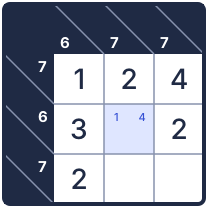
In the diagram, the across run of 3 in 2 cells allows 1 and 2. The down run of 4 in 2 cells allows 1 and 3. Only 1 is in both lists, so the shared cell is 1. The other cells follow: 3 − 1 = 2, and 4 − 1 = 3.
| 4 | ||
| 3 | 1 | 2 |
| 3 |
3. Use the high and low limits
A cell can never hold more than the clue minus the smallest sum of the other cells. It can never hold less than the clue minus the largest sum of the other cells.
In 2 cells, a clue of 15 needs each cell to be at least 15 − 9 = 6. So both cells hold 6, 7, 8 or 9. In 2 cells, a clue of 5 lets each cell be at most 5 − 1 = 4.
| 15 | 6 7 8 9 | 6 7 8 9 |
4. Remove the digits a run already uses
A run never repeats a digit. When you place a digit, remove it from the notes of every other cell in that run.
Here, a run of 3 cells adds up to 13 and already has a 9. The other two cells must make 4. That is 1 + 3, because 2 + 2 repeats a digit.
| 13 | 9 | 1 3 | 1 3 |
5. Fill the last cell of a run
When a run has only one empty cell, that cell is the clue minus the digits already in the run. Check that the answer is from 1 to 9 and is not already in the run.
| 20 | 2 | 5 | 4 | 9 |
6. Add up a whole area
This method is for hard puzzles. Pick a block of runs. Add all its across clues, then add all its down clues. Any difference between the two totals comes from cells that stick out of the block.
In the diagram, the shaded block has across clues 4 and 16, and down clues 3 and 8. The across runs also cover one cell outside the block. That cell is (4 + 16) − (3 + 8) = 9.
| 3 | 8 | ||
| 4 | 14 | ||
| 16 | 9 | ||
When you are stuck
- Go back to method 2 for every cell with only two or three possible digits.
- Look for a digit that can go in only one cell of a run.
- Look at the longest runs. A run of 8 cells misses only one digit, and the clue tells you which: 45 minus the clue.
Practice on iPhone
Cross Sums has free daily Kakuro and Calcudoku puzzles. Its hints explain the next step, not just the answer. See the app.